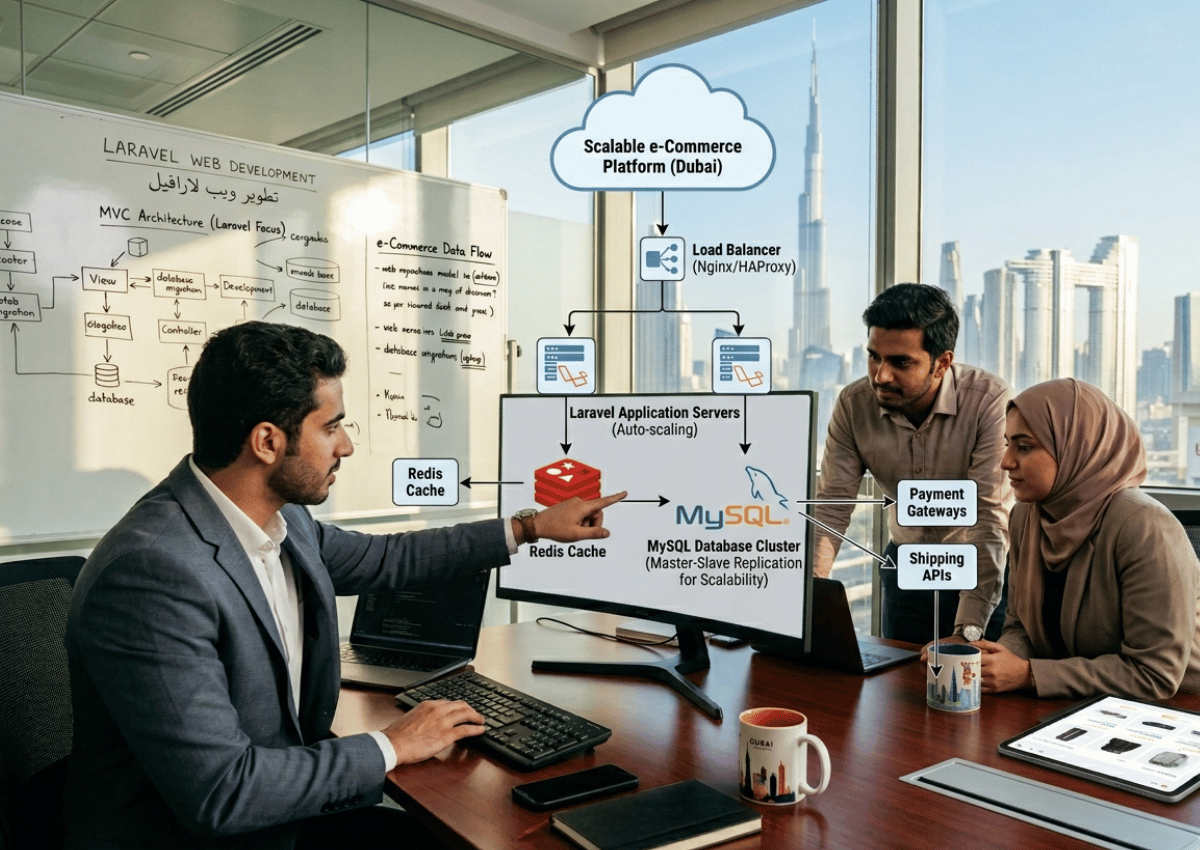
Building an e-commerce website is one of the most common and important web development projects undertaken by businesses in Dubai and across the UAE. The region's e-commerce market has experienced explosive growth in recent years, driven by high smartphone penetration, a tech-savvy consumer base, and a business environment that actively encourages digital innovation. However, building an online store that simply works is very different from building one that scales. A scalable e-commerce platform is one that can handle growth gracefully — whether that means doubling your product catalog, handling a flash sale that brings thousands of simultaneous visitors, or expanding to serve customers in multiple countries. Getting the architecture right from day one is the difference between a platform that grows with your business and one that becomes a bottleneck to your success.
Laravel and MySQL together form one of the most powerful and proven technology stacks for building scalable e-commerce platforms. Laravel's elegant architecture, built-in performance tools, and rich ecosystem provide everything needed to handle complex business logic, high traffic volumes, and sophisticated integrations. MySQL's mature relational database engine, combined with proper schema design and query optimization, ensures data integrity and retrieval performance even as your product catalog and order volumes grow into the millions. When these two technologies are combined with the right architectural patterns and best practices, the result is an e-commerce platform that is not only powerful today but ready for whatever growth tomorrow brings.
Planning Your E-Commerce Architecture
Before writing a single line of code, the most important step in building a scalable e-commerce platform is careful architectural planning. Many developers make the mistake of jumping straight into implementation without thinking through how the system will evolve as requirements grow. A well-planned architecture considers not just the features needed at launch, but the likely growth trajectory of the business — including expected traffic volumes, catalog size, geographic expansion, and integration requirements. This upfront investment in planning pays enormous dividends down the road by avoiding the costly and disruptive architectural rewrites that plague many growing e-commerce platforms.
The foundation of a scalable Laravel e-commerce architecture is a clean separation of concerns. Business logic should be encapsulated in dedicated service classes rather than bloated controllers. Database interactions should be abstracted through repositories, making it easy to optimize or replace the data layer without touching business logic. Event-driven architecture, enabled by Laravel's event and listener system, allows different parts of the application to communicate asynchronously — for example, triggering inventory updates, email notifications, and analytics events whenever an order is placed, without coupling these concerns together in a single function.
Database Design and Optimization
The database is the heart of any e-commerce platform, and its design has a profound impact on both functionality and performance. A well-normalized MySQL schema ensures data integrity and eliminates redundancy, while strategic denormalization in the right places can dramatically improve query performance for read-heavy operations. The product catalog schema deserves particular attention — a flexible design that supports product variants, multiple images, custom attributes, and category hierarchies requires careful thought to implement in a way that is both functionally rich and performant at scale.
Indexing is one of the most powerful and underutilized tools for improving MySQL performance. Every column used in WHERE clauses, JOIN conditions, and ORDER BY operations should be evaluated as a candidate for indexing. Composite indexes, which cover multiple columns in a single index, can dramatically improve the performance of complex queries that filter and sort on multiple conditions simultaneously. Laravel's migration system makes it easy to add and manage indexes as part of your schema definition, ensuring that proper indexing is built into the database from the start rather than added as an afterthought when performance problems arise.
For large catalogs and high-volume order tables, MySQL table partitioning can significantly improve query performance by dividing large tables into smaller, more manageable pieces. Orders older than a certain date can be partitioned into historical archives, keeping the active orders table lean and fast. Product search performance can be dramatically improved by implementing full-text search using MySQL's native full-text index capabilities or, for more advanced requirements, integrating a dedicated search engine like Elasticsearch or Algolia through Laravel's Scout package.
Caching Strategies for E-Commerce
Caching is one of the most effective techniques for improving e-commerce platform performance and scalability. Laravel provides a unified caching API that supports multiple cache drivers including file, database, Redis, and Memcached — allowing developers to choose the right caching backend for their performance requirements. For a high-traffic e-commerce platform, Redis is the recommended choice — it is an in-memory data store that delivers microsecond response times and supports advanced data structures that make it ideal for caching complex objects like product listings, category trees, and user sessions.
Effective caching strategy for e-commerce involves identifying the data that is read frequently but updated infrequently, and storing it in the cache to avoid repeated database queries. Product details, category listings, promotional banners, and navigation menus are all excellent candidates for caching. Laravel's cache tagging feature allows related cached items to be grouped and invalidated together — for example, all cached data related to a specific product can be invalidated instantly when that product is updated, ensuring customers always see accurate information.
Page-level caching, where entire rendered HTML pages are cached and served directly without executing PHP code or querying the database, can deliver dramatic performance improvements for product listing pages and category pages that do not change with every request. For authenticated users with personalized content like cart items and wishlists, fragment caching — where only the non-personalized portions of a page are cached — provides a good balance between performance and personalization.
Queue Management for Background Processing
A fundamental principle of scalable web application design is to keep the request-response cycle as fast as possible by offloading time-consuming work to background processes. In an e-commerce context, there are numerous operations that should be processed asynchronously rather than synchronously during the user's request — including order confirmation emails, invoice PDF generation, inventory updates, payment webhook processing, search index updates, and promotional notification campaigns. Laravel's queue system provides an elegant solution for all of these use cases, allowing developers to dispatch jobs to a queue and process them in the background using dedicated worker processes.
Laravel supports multiple queue backends including Redis, Amazon SQS, and database queues, giving developers the flexibility to choose the right backend for their infrastructure. Redis-backed queues offer the best performance for high-throughput scenarios, handling thousands of jobs per second with minimal overhead. Laravel Horizon, the framework's official queue monitoring dashboard, provides real-time visibility into queue throughput, job processing times, and failure rates — making it easy to identify and resolve performance bottlenecks in the background processing pipeline.
Payment Gateway Integration
A critical component of any e-commerce platform is a secure and reliable payment processing system. For businesses in the UAE, payment gateway options include international providers like Stripe and PayPal as well as regional providers like Telr, PayTabs, and Checkout.com that support AED transactions and local payment methods. Laravel's architecture makes payment gateway integration straightforward, with dedicated service classes handling the communication with payment provider APIs and event-driven architecture ensuring that order status updates, email notifications, and inventory adjustments happen reliably in response to payment events.
Security is paramount in payment processing. All payment data should be transmitted over HTTPS and sensitive card data should never be stored on your servers — instead, using tokenization provided by your payment gateway to store a secure reference to the payment method. Laravel's CSRF protection, input validation, and encryption features provide important layers of security around the payment flow, while webhook signature verification ensures that incoming payment notifications are genuinely from your payment provider and not from malicious third parties.
API-First Architecture for Multi-Platform Support
Modern e-commerce businesses rarely operate on a single platform. Today's customers expect to shop through a web browser, a mobile app, and increasingly through social commerce channels — all connected to the same backend data and business logic. Building your e-commerce platform with an API-first architecture from the start ensures that your backend can serve all of these channels without duplication. Laravel's API resource classes, Sanctum authentication, and powerful routing system make building a comprehensive RESTful API alongside your web application straightforward and maintainable.
An API-first approach also makes future integrations significantly easier. Whether you need to connect your e-commerce platform to a warehouse management system, an accounting package, a CRM, or a marketing automation tool, a well-designed REST API provides the integration surface that these systems need. Webhooks — outgoing HTTP requests triggered by events in your application — complement the API by enabling real-time data synchronization with external systems without requiring them to continuously poll your API for updates.
Conclusion
Building a scalable e-commerce platform with Laravel and MySQL is both an art and a science. It requires careful architectural planning, disciplined database design, strategic use of caching and queues, secure payment integration, and a forward-thinking API-first approach that prepares the platform for multi-channel commerce. The businesses that invest in getting this foundation right from the start are the ones that can scale confidently, move fast when opportunities arise, and deliver the fast and reliable shopping experience that today's customers demand. Whether you are launching your first online store or rebuilding an existing platform to handle your next stage of growth, Laravel and MySQL provide the tools and the proven track record to take you there.